
by Thomas Richards-Keyes and Lisa Ruth Zomer
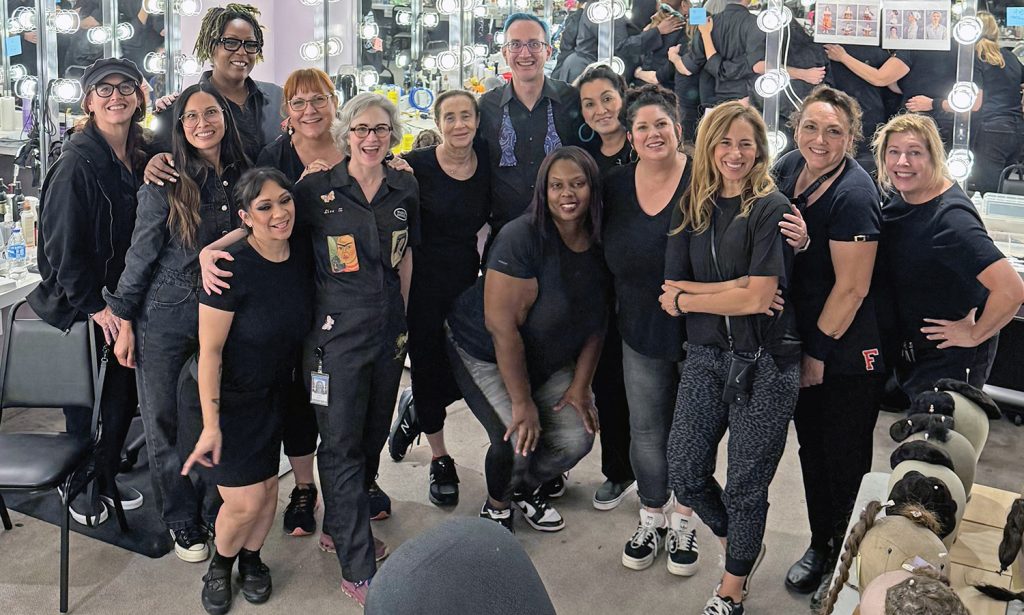
Lisa Zomer, Kimberly Robinson, Thomas Richards-Keyes, Victoria Lee, Carol Mitchell,
Joyce Cantrell, Marylou Hernandez, Tasha Calderon, Karen Zanki Photo by Victor Del Castillo
Thomas Richards-Keyes
Head of Hair and Makeup at San Francisco Ballet
I’m excited to be involved in San Francisco Ballet’s telling of Frankenstein through dance, from the 2017 creation to our tour to Costa Mesa. Our San Francisco Regional Local 706 hairs stylists and make-up artists have been incredible over the years and made it all possible to get such a large production well prepared and able to tour.
A co-production with the London Royal Ballet, it became one of the largest productions the company has ever taken on the road. The team at Segerstrom Center for the Arts, headed by Kimberly Robinson, was a pleasure to work with, even better knowing the crew were all Local 706 sisters and brothers.
A ballet co-production means sets/costumes/etc., are shared between the two companies to split the creation costs. In this case, hair and make-up were kept in-house with wigs and hairpieces built by Campbell and Associates specifically for our dancers back in 2017, while the SFX make-ups in turn are locally created fresh for every run.
I’m Head of Hair and Makeup with Lisa Zomer as Deputy Head. With my background in wigs and hair, and Lisa’s in make-up, we run the department as specialists leading each of our craft’s crew. This is one of the largest crews we hire for the ballet, bringing together a total of 15 Local 706 artists. I manage the core team of seven hair stylists and four make-up artists, leaving Lisa free to focus on the effects team, including herself and two SFX artists.
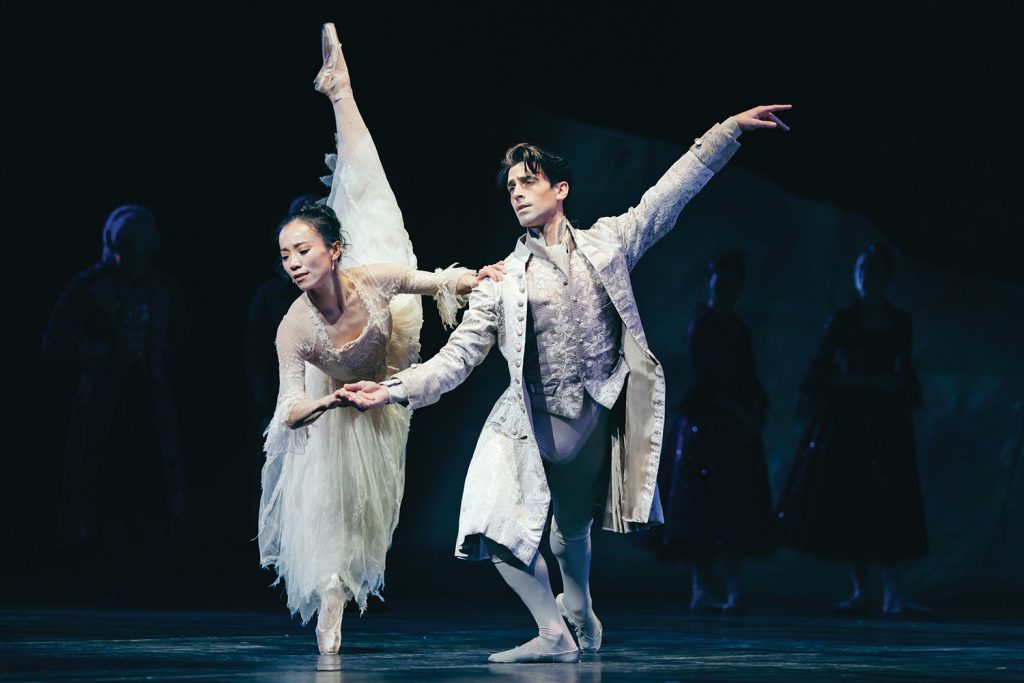
Choreographer Liam Scarlett and costume designer John Macfarlane set the show in a general 18th-century look. Acts 1 and 2 take place in the real world with natural period hair styles, and Act 3 shifts into a dreamlike fantasy of shadow and rich colors with more fanciful and colorful period hair.
Men wear their natural hair with a hand-tied human hair back-flap piece tied back into a queue. We make mini-ponytails with small elastics, applying SexyHair Big Powder Play to get their short hair as grabby as possible. The back flaps have toupee clips sewn-in, we attach those to the ponytails and add bob pins for extra hold. Their hair is styled with Kenra Volume Mousse 12 to bring out any natural curl without looking too crisp. I’ve found the Kenra is stickier than other brands and it holds up well to heavy sweating through a full dance performance. On especially sweaty dancers, we finish the look with a spray of Got2B Glued or TRESemme Non-Aerosol Extra Hold.
One hair stylist is stationed on each side of the stage for the entire show in case any pieces slip mid-performance.
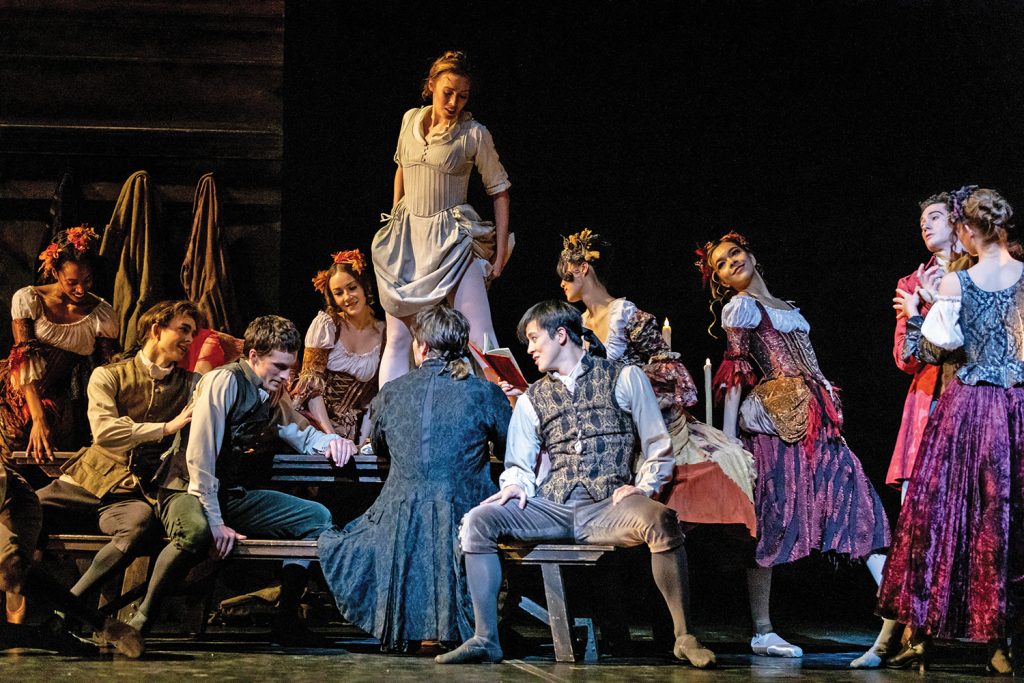
A group of five named characters wear tie-back wigs. The wigs are hand-tied yak hair with side-rolls and minimal lift on top, making them more mundane in appearance. We use a prep of elastic headband, mesh wig cap, pop-clips, and wig pins. If the dancer requests it, we use W.M. Creations Spirit Gum.
One woman wears a wig, the mother of Victor Frankenstein’s childhood friend, Justine, a salt-and-pepper hand-tied human hair wig in an elegant up-do.
Three principal women get their natural hair styled in soft up-dos of curls dressed over a French twist or down from a high ponytail. Principal dancers are assigned to one hair stylist with the freedom to create the look together, working from the base structure in the design.
Eight children play the principal characters in the opening scenes, one of whom is Victor’s younger brother throughout the show. We style the boys’ natural hair with Joico Joigel Firm #8 set with hairspray and the girls’ hair up in a soft bun, with bonnets to match the silhouette of their adult selves.
Nearly 30 female dancers prep their hair into a French twist, leaving out an ear-to-ear parting over the top of the head secured into three pin curls. We adapt this style into three looks without needing to fully restyle their hair.
Staff and lab women wear bonnets that fully cover the head. Later in Act 1, there’s a tavern scene with a group of wenches. We release the pin curls and use curling irons with Chi 44 Iron Guard to create textures that we tease and secure in a wild carefree look, with a headband of loose flowers.
The women’s third look involves a set of more than 30 curled postiches in a range of colors and textures to match any possible casting rotation of dancers. The pieces are dressed in medium curls locked into place with pins and a fine hair net. We take down the pin curled sections, pin a postiche on top of the French twist, then iron a wave into the front pieces to dress back and blend with the postiche.
Nearly everything up to this point is completed one hour before the show begins. In that time, I’m also styling while staying ready to jump in if there’s any issues. We sometimes team two or more crew members to speed through if a dancer is running late or there’s a last-minute change to casting. On this tour, we had emergency cover dancers going into roles who had never been fit in any of the wigs—a key reason I have the crew unblock everything.
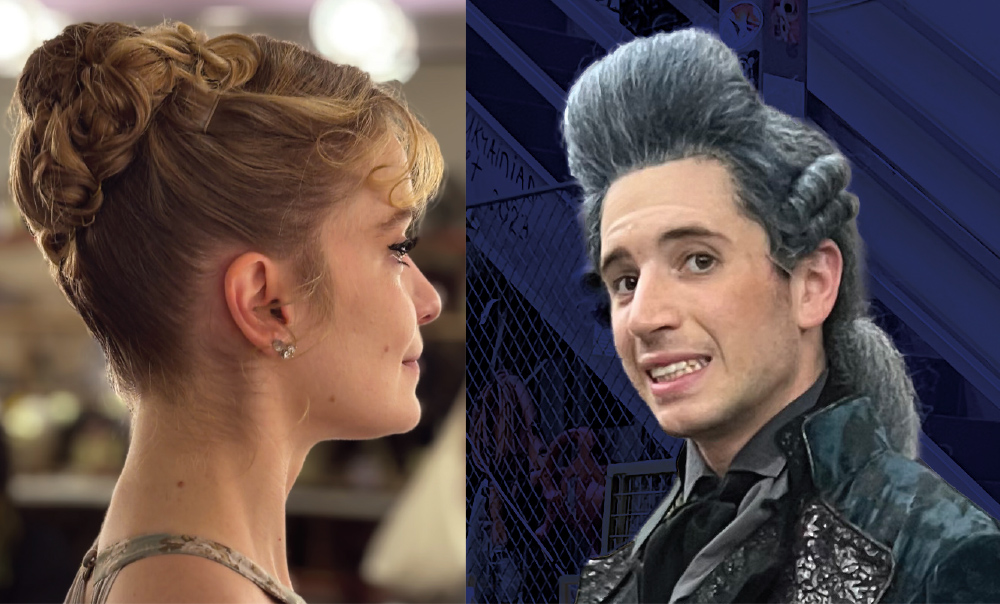
For the dreamlike final act, the corps dancers become 20 ballroom couples, during a 20-minute intermission, including full costumes. The men switch out of their queues into tie-back yak-hair wigs in blue, silver, or burgundy, matched to their costume. Each has one to three rolls on the sides, tall pompadours, and big fluffy ponytails. We use the same prep as earlier, with large pins and no glue.
The women bring rhinestone crowns matched to their dresses. We release the front pieces from their previous role and add a curled postiche if they don’t already have one. The crown is placed, tied at the nape and secured with bob pins. Then we dress the front pieces in an elegant sweep over the sides of the crows and pin them to blend into the postiche.
At the end of the show, we remove and block the wigs, queues and postiches. Coming full circle, two hair crew and I start an hour ahead of the regular crew to restyle the wigs, queues, and postiches. It’s an intense cycle that’s also deeply satisfying through the shared energy of the dancers and audience.
Lisa Ruth Zomer
Deputy Head of Makeup and Wigs at San Francisco Ballet
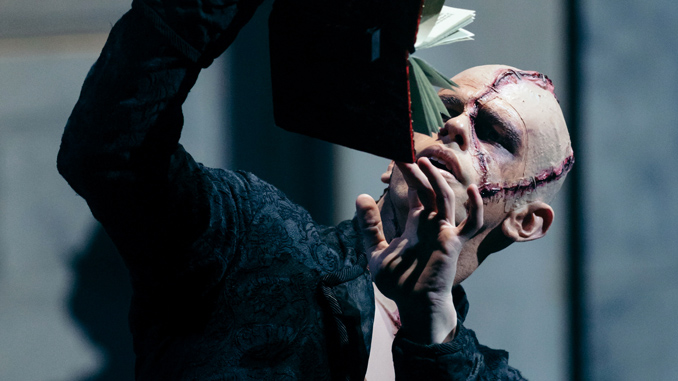
My tour with San Francico Ballet’s Frankenstein began back in 2017 when the creature designer Tim Santry called and asked if I would be his assistant on the new production of Frankenstein. Tim has been one of my mentors and a close friend from the beginning of my time working in San Francisco and we’ve helped each other out on many jobs over the years. I knew we would have a great time and good working chemistry from the start, so I enthusiastically agreed to come on board. Over the next two years, I assisted Tim in the casting and application of the creature make-up for the performance runs in 2017 and 2018, barely seeing the inside of the usual make-up room at our home base in the War Memorial Opera House. I had no idea that five years later, I would join the company as Deputy Head of Makeup and Wigs, taking on a completely new role within the company itself, and therefore, the new run of Frankenstein, but I am so grateful for that time as it prepared me for what was to come.
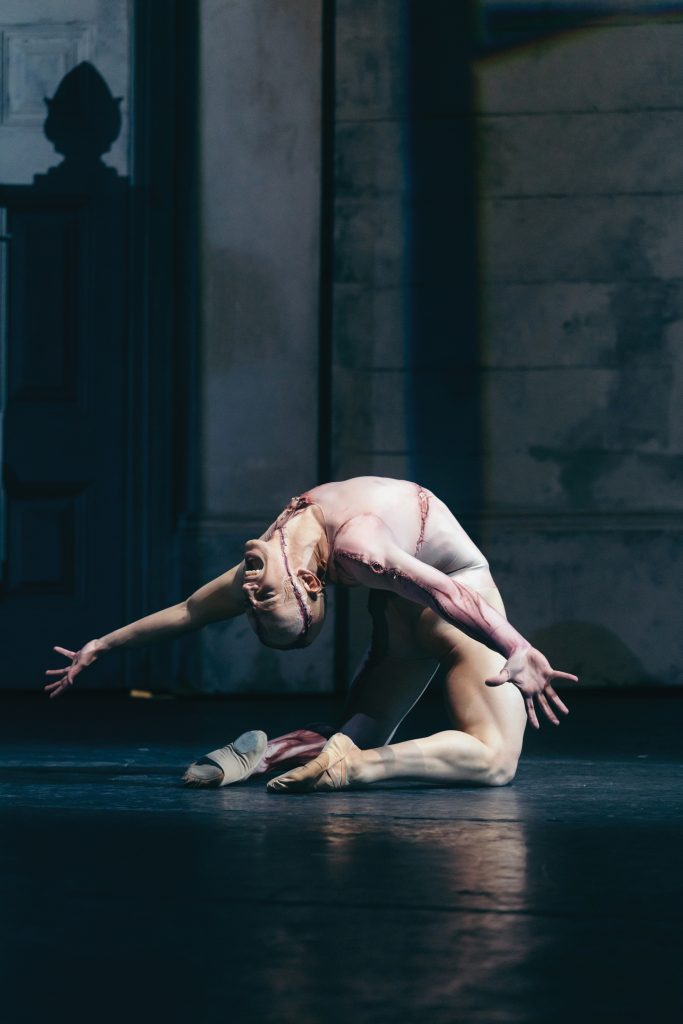
Tim had been entrusted with the original make-up design of Frankenstein’s creature and worked from the original costume concept to incorporate a make-up that would work for the dancers but also stay true to the design of the production. Each creature begins with casting the head and chest of the dancer with Smooth On silicone products and then making a bust out of Hydrocal. Tim then sculpts and manufactures the head pates and scars over the course of several days with each performance requiring a set of scars and a pate that is disposed of after the show. Initially, we had tried to clean them for reuse, but it quickly became apparent that doing so was a losing proposition. Because of the strenuous movement and the lack of touch-up time, the make-up had to last through more than 3½ hours of stretching and friction from costumes and partner dancing, not to mention a profuse amount of perspiration.
By the time the Frankenstein production came around again, my role had shifted and I needed to look at our home performances in a completely new light. I was now leading our make-up team and turned over my assisting duties to Jordan Plath for the initial run of the show. However, for our encore run, I had to learn to create the creature on my own so that I could train whoever would be assisting me when we went on the road as it would only be Thomas and I traveling with the company for our department. Both Tim and Jordan were patient and generous teachers, giving me the time to think through the steps and work on my muscle memory. In the end, it worked beautifully because I was able to confidently recreate our creature on the road with my Costa Mesa team, Victor Del Castillo and Bruna Nogueira.
Most of the make-ups in the show are fairly straightforward beauty make-ups. Joe Walsh—one of the dancers who portrays the character of Victor Frankenstein and also serves in the role of stage director—collaborated with me to help create an image of a man slowly falling into madness, tormented by the consequences of his own making. Act 1 begins with a beauty make-up emphasizing his features and contouring and highlighting his face. However, Act 1 is very energetic for Victor as he expresses his excitement in bringing the creature to life. By the time Victor exits the stage, he is drenched and catching his breath, so on tour, I assigned an artist to take over my role and spend a few minutes to help dry him off, check his queue, and reapply the make-up that had melted off. In Act 2, Victor sees the death of his little brother and starts to realize that his creation is not all well and good and that perhaps there were boundaries that shouldn’t have been breached. Between Acts 2 and 3, we try to show the darkened, hollowed eyes and face of a man descending into madness by applying a dark gray shadow in his eye sockets and heavily deepening his cheek contouring.
Our home team crew for Frankenstein includes me and four make-up artists in addition to the two effects artists solely dedicated to the creature. When the hair team is added in, it makes for a very busy and crowded room. Since the creature is such an intensely demanding role, both emotionally and physically, we wanted to treat the make-up process much differently from our typical theater setup and create a quiet area for the dancer who performs the role instead of having them prepare in the same room in where everyone gets their wigs and make-up done. Additionally, the costume is quite sheer, and a lot of body painting happens, so the separate room offers some privacy, as well as space for working. We had a good solution for this in the Opera House by using another men’s dressing room down the hall from our make-up room. However, when we went on the road, we found that there was not an available space solely for the creature make-up and we all ended up with my road crate, our barber’s chair, and a table set up in a men’s bathroom which created a special environment when our artistic director came to observe us and the motion detector urinals kept flushing during the process!
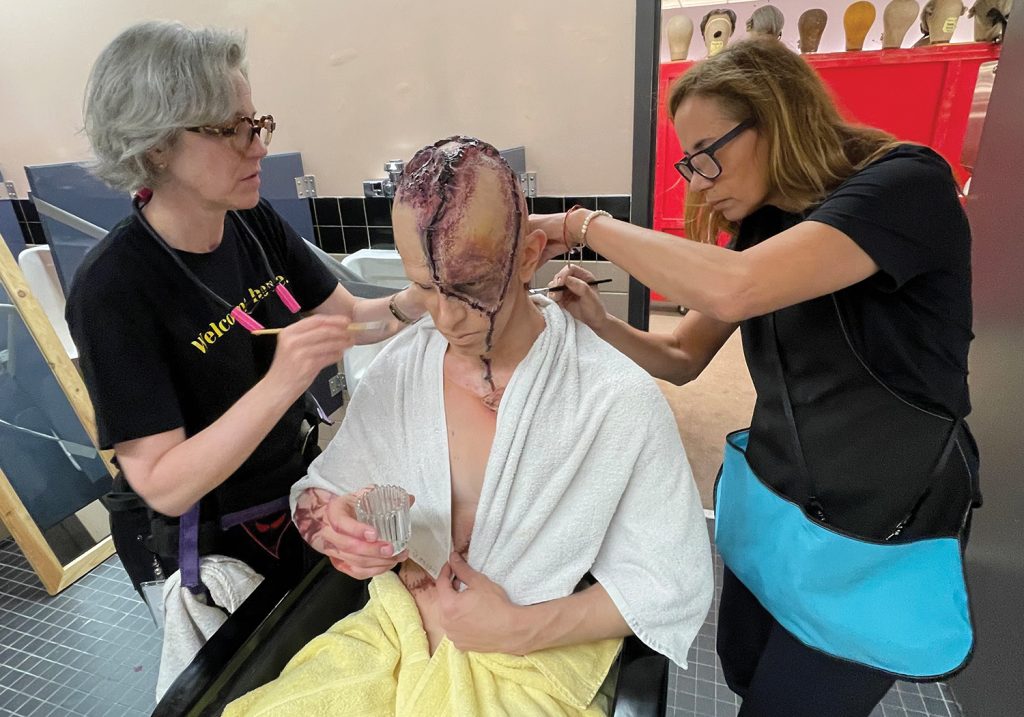
While there are many steps to achieving the final look, the two artists assigned to the creature must work in tandem to complete everything on time. The make-up takes an hour and a half—an incredibly long process in the theater world! Once any tattoos are covered, the bald cap application begins. We use two types of skin protectant (Marly Skin and Telesis Top Guard were our lifesavers when a dancer had an allergic reaction to the latex prosthetic cap!) and lay down a glatzan cap underneath where the prosthetic cap will be placed. The glatzan cap holds in some of the sweat that comes off the dancer’s head and prevents the prosthetic from sliding around. Avoiding and directing sweat is a huge factor in making sure that everything stays put so when laying the cap down, we leave channels over the ears and at the back of the neck for sweat to run out of. Once the first cap is down, we set the prosthetic cap, taking care to match the ventilation channels. Next come the scars that have been pre-painted with PAX to match each dancer’s face and neck. After all the prosthetic pieces are laid, the sealing and final painting begins. One artist seals while the other paints with Kryolan BIC, Illustrator, and EBA palettes to blend and enhance the scars before applying generous amounts of Fresh Scab Gel to the scars and the large indent in the creature’s head. We highlight and contour the creature’s head and neck to create the impression of gauntness and bruising, especially around the left eye.
The most intense part of this make-up is watching the dancer move and knowing that our touchups will be fast and few between. While sparks fly and our creature awakens, we cross our fingers that none of them land on his skin. Our touchup time between Acts 1 and 2 is therefore easy but it doesn’t really let us know if there are any issues about to pop up. In the second act, the creature dances and moves a lot more so we have a couple of moments under dim headlamps to see how things are holding up, squeeze as much perspiration out of the cap as possible and touchup glue. At the end of Act 2, we use the 20-minute intermission to peel up the entire back of the cap, dry the dancer out while being careful not to chill the muscles, and reapply the entire back of the glatzan and prosthetic caps with telesis and a lot of prayers.
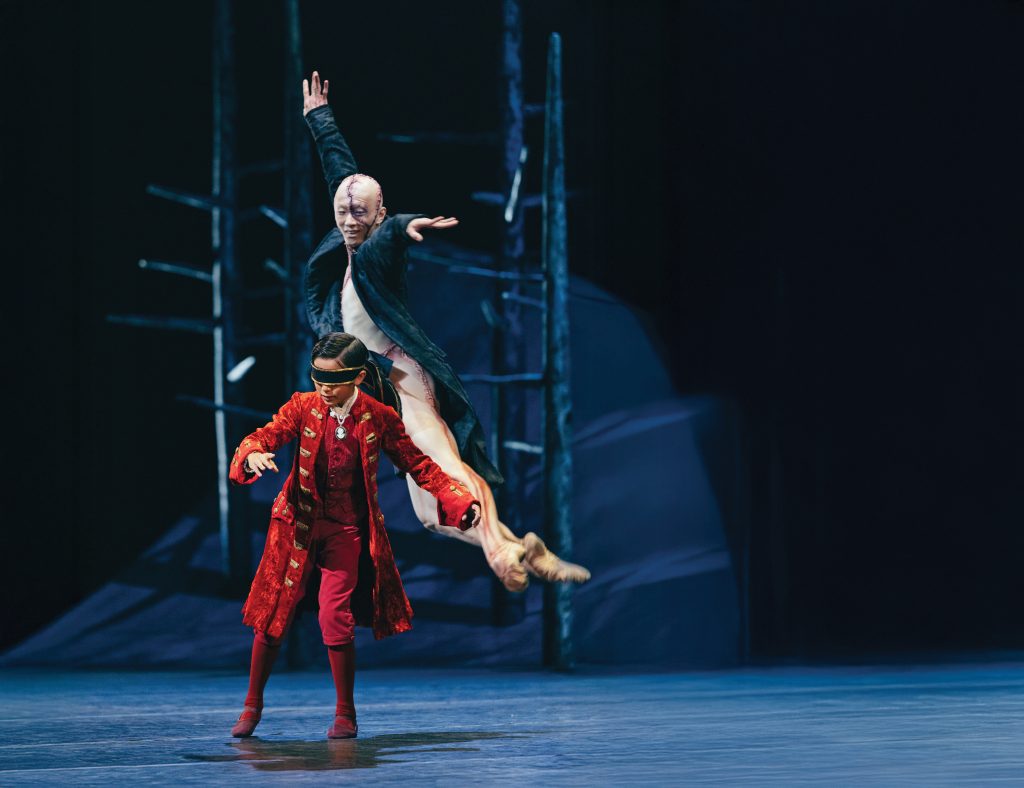
The third act is the most intense and strenuous for the dancer and shows so much of the conflicting emotions of the story—between longing and rage, jealousy and disgust, as well as love and regret. To show all of this, the dancer, both alone and in partnership, oscillates between beauty and writhing, dancing alone, as well as in the impressive pas de deux with Victor Frankenstein that puts tension on the pieces for almost the entire act. Once we’ve sent the dancer off, all we can do is watch and hope that the glue holds and finally release our breath when it does.
I was trained mainly in film and still photography make-up techniques, so my work has always been minute, with the ability to course correct if there was an issue with the make-up. Learning to work in the world of theater where you must let go and enjoy the wild ride has been a challenge and a joy. None have been as complex and satisfying as Frankenstein’s creature to date. Collaborating with the dancers of the San Francisco Ballet and the make-up artists back home, as well as the locals in Costa Mesa was an amazing time that I am looking forward to repeating.
Last, we need to thank both hair and make-up teams for their amazing work. For SF Ballet: The Creature Team: Tim Santry (designer), and Jordan Plath (assistant). Makeup Team: Mari Garcia, Toby Mayer, Lisa Patnoe, and Vanessa Lee. Hair Team: Robert Mrazik, Marcelo Donari, Jenny-King Turko, Shana Astrachan, Raegina Joyner, Leilani Norman, Kristen Campbell, Erica Villanueva, Christina Martin, Karalynne Fiebig, Vanessa Root, and Calli Carvajal.
For Costa Mesa: Makeup Team: Victor Del Castillo, Donna Levy, Bruna Nogueira, Amy Sparks, and Tania Vega. Hair Team: Kimberly Robinson, Carol Mitchell, Flo Witherspoon, Joyce Cantrell, Karen Zanki, Marylou Hernandez, Tasha Calderon, Teresa Mariscal, and Victoria Robinson. We could not have done it without you. •