
AN OVERVIEW OF MAKE-UP DESIGN,
PROSTHETIC MAKE-UP DESIGN, AND HAIR DESIGN
Photos courtesy of Lorenzo Sisti/Prime
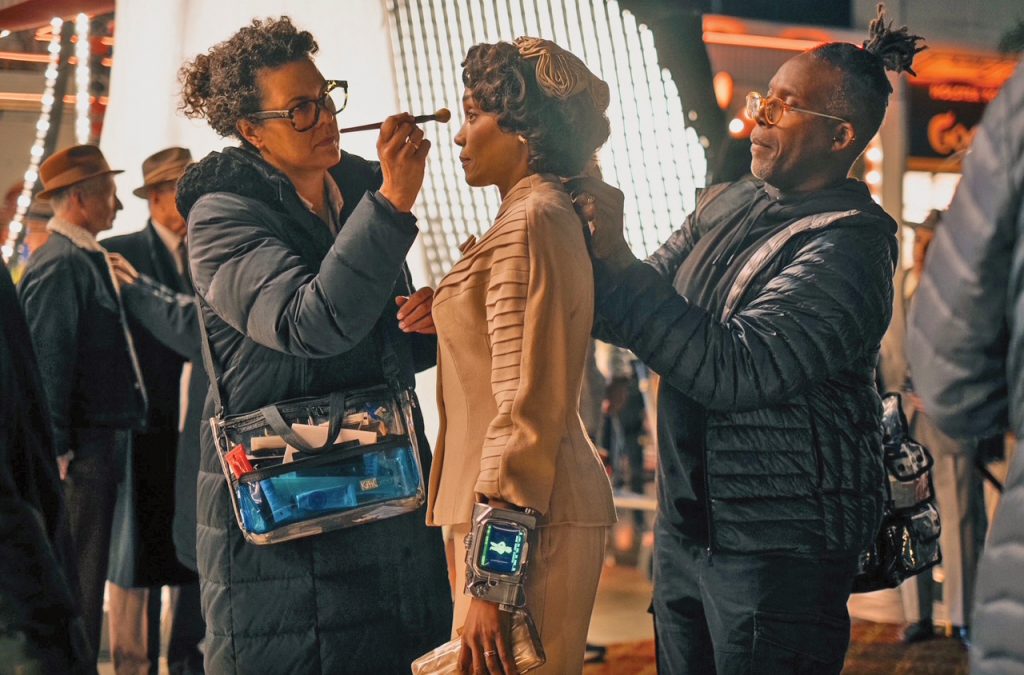
Elisa Marsh, Make-Up Designer:
At my first meeting, I learned that Season 2 would introduce several new factions from the game. When Dayna Pink, our costume designer, shared her illustrations of the cast, Khans, NCR & the Legion, I was inspired and eager to begin.
With pre- and post-apocalyptic storylines, our work was to define the expanding world of Fallout. It was important to make choices that would visually anchor the audience as we introduced new characters and watched these worlds collide. It was also important to me that the make-up in the pre-apocalyptic 1950’s era was as true to the era as the production design and fabulous costumes.
The make-up changes in S2 are script-driven. Our characters on the surface travel through the wasteland on their journeys, becoming more distressed from injuries, fights, and increasing exposure and grime.
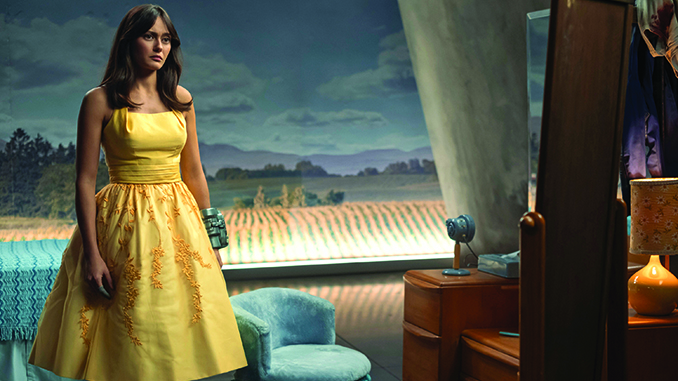
Lucy got to ‘freshen up’ only twice; once after nearly dying in the Legion camp, and then in the final episode when she wears the yellow dress. The sunburn and exposure were created with Illustrator and gel paints. I was impressed with the ease of Maekup Dry Lip. Her look for the yellow dress was the first time that we saw Lucy free of her layers of grunge pallet and ash powder. Though having bare arms and legs meant there was a lot of tattoo coverage to be done. This was done by airbrushing Endura liquids.
John Damiani skillfully took care of Maximus’s scars & battle continuity. He has two established scars, one on his brow bone carried into the eyebrow and one on his chin. Both silicone appliances are color tinted to match skin tone, then blended with 99% alcohol, painted with a wash of Illustrator palette, sealed, then stippled with Nanoblur to take down any shine. Maximus’s scratches and bruises were all Out of Kit. Painted with Illustrator and Bluebird palettes, sealed with Endura spray and standard Red Drum blood was added to bring life to the wound.
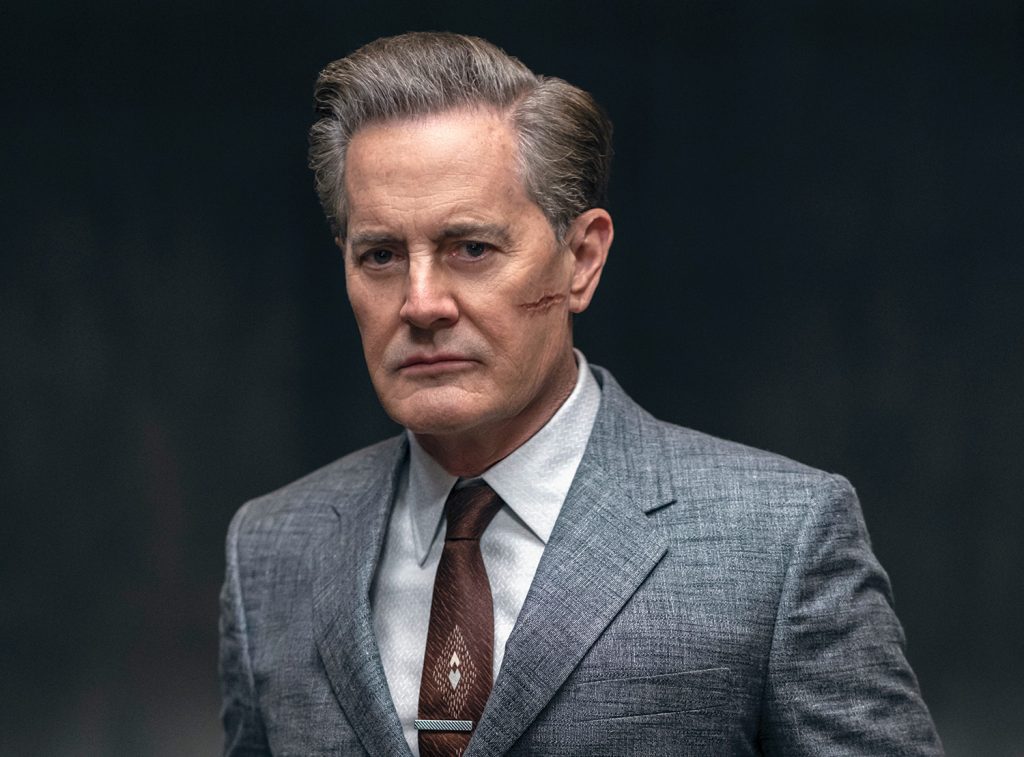
Norm was in rough shape and had been left to starve in Vault 33. To create an emancipated look, we painted redness and purple discoloration around his eyes, nasal area, and neck. Very dry lips were painted with Illustrator, Maekup Dry Lip and of course, the usual Fallout layer of dirt and grunge palettes. Hank appears out of S1 wearing full Power Armor grimy with a dried bloody gash across his cheek. For the rest of the season, Hank is back to his clean-cut self, wearing a suit. For this look, he had a straight corrective make-up with a Pros-Aide transfer scar across his cheek. In the flashbacks, Jennifer Aspinall supported visual effects in his de-aging by using Skin Saver Barrier lotion, Dermalogica Power Firm eye cream, and Smash Box photo finish primer applied to help fill in lines and wrinkles. Opsite tape was used to pull back the skin on the neck, textured with Pros-Aide and painted to match skin tone.
We meet Steph dirty, sweaty, running for her life. Next, she is clean faced wearing red lipstick as a perfectly groomed ’50s chambermaid. Then in a fully made up polished ’50s make-up.
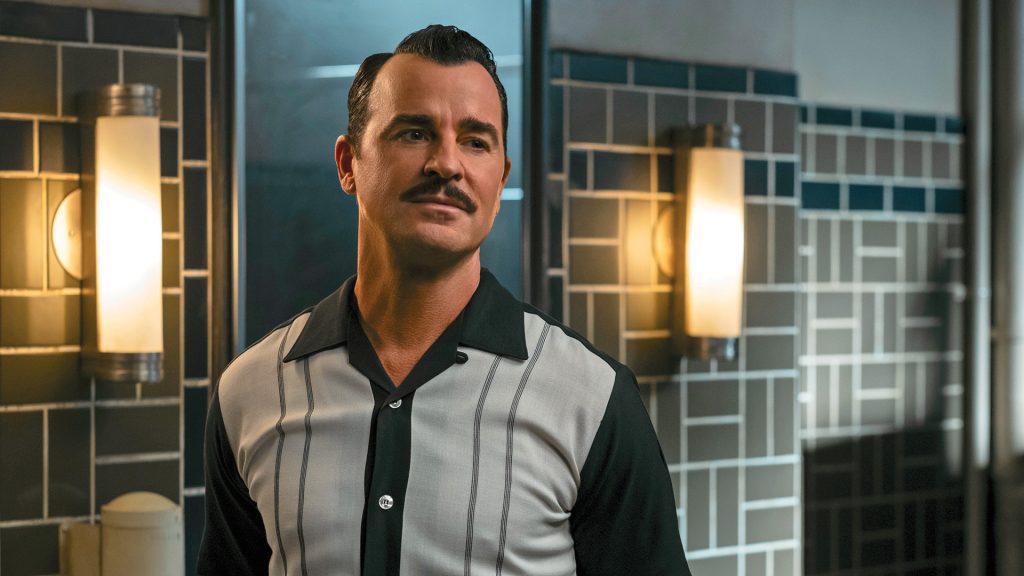
A big reveal this season was the real Robert House. My task was to design a mustache that is true to the game, looking like Robert House of S1 and most importantly, looking great on our actor, Justin Theroux. I called Zoe Hay and presto! Magic.
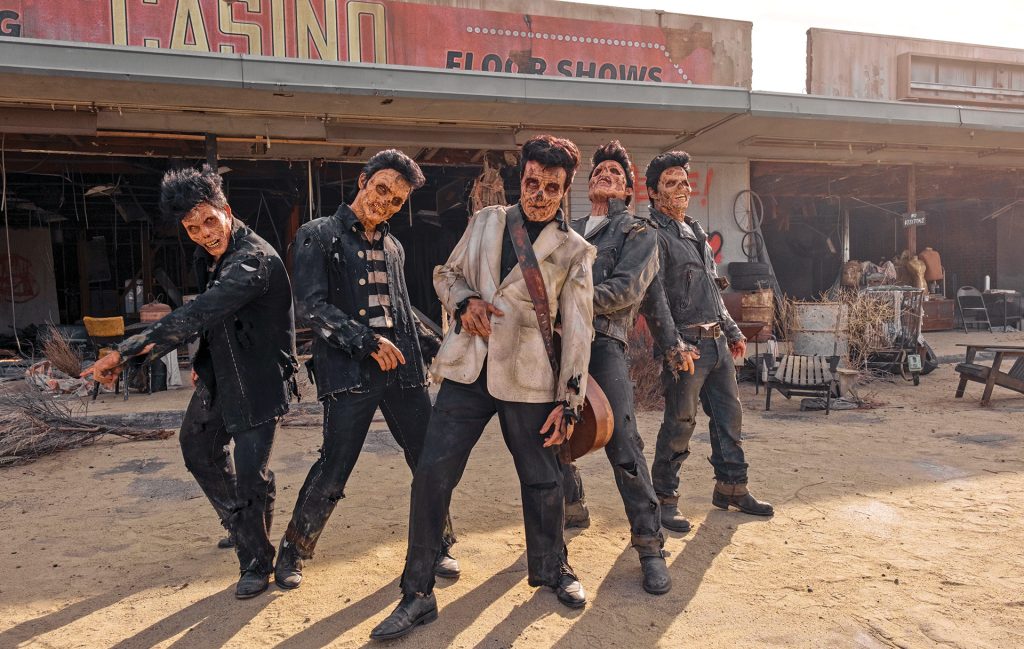
We introduced the Khans. A raider tribe that lives on the surface, they have sun, exposure, layers, and layers of dirt and grime, and very rotten teeth. We meet a group affectionately titled ghoul and boil kids. We had two artists for each child but only had eight hours to get them set-ready, film, and clean them up. Another example of the brilliant collaboration of make-up, costume, hair, and make-up FX.
The Legion is violent, scary, soldier-like, modeled after the Roman Empire complete with slaves. This group required tattoo coverage, body paint & layers of dirt, as well as battle scars, old and new. A portion of the Legion wore white-face paint that was designed to crack as it dried, which was then aged with dirt work sprays and powders.
Freeside is filled with characters. Each BG artist is dressed differently and trying to survive by holding on to their past identities. showgirls, croupiers, dealers, shop owners & patrons all received individualized detailed character make-ups.
In closing, I would just like to say how amazing it was to be shooting in Los Angeles and how grateful I am to John Damiani, Jennifer Aspinall & every single artist we worked with. We had the best crew, such a talented, hardworking & generous group of people. Thank you!
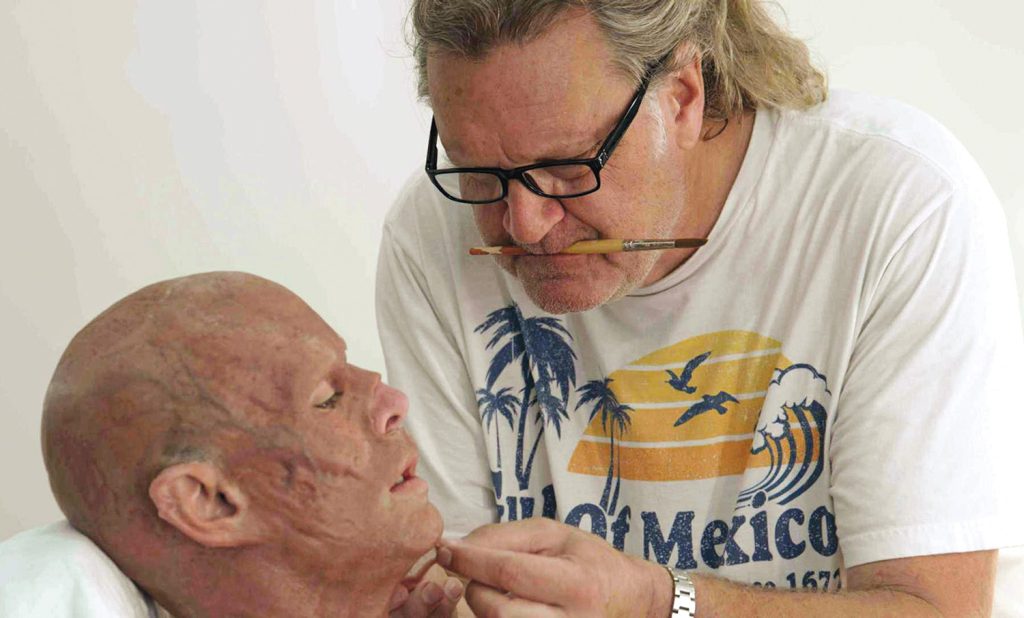
Jake Garber & Vincent Van Dyke, Prosthetic Make-Up Designers:
JG: In addition to Walton Goggins’ make-up as The Ghoul, we now had a new challenge in creating Johnny Pemberton’s new look as Thaddeus.
VVD: I was called upon for this design and prosthetic construction. We weren’t sure what he would be turning into and what his subsequent “being” would be, but we pushed on in concept.
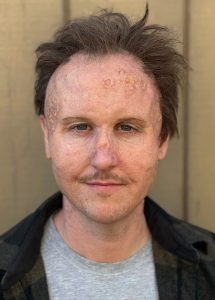
JG: We did an initial test which was a bit much, so it was dialed back to three silicone prosthetics and some hairpieces. The three appliances consisted of a forehead, which went well behind his hairline and two sides of face. This make-up was a very exacting process due to the subtleness of his look, and I feel it is a much more challenging make-up than The Ghoul which is subtle, but more extreme. Any misstep in the application would become very apparent. Coloring was minimal and hand-painted with no airbrush use. The daily application was handled at different times by Vincent Van Dyke, Greg Funk, Gabriel De Cunto, and Scott Stoddard.
VVD: We started this much like we did with The Ghoul, where we dive into sculpture straight away. After Johnny came into the studio for his scan, we went right into producing his master molds and castings for this sculptural exploration that myself and lead sculptor Daniele Tirinnanzi started on. These looks consisted of a more extreme and a more subtle version—which led us down a path of the more extreme side of things. We explored this all the way through into a make-up test, which was determined to be a bit too much. Some resculpting was done and another test that myself and Greg Funk established to lock in his final look. We opted to keep his nose and around the mouth free. Everything was painted by hand and kept very subtle—matching a lot of Johnny with introducing subtle veining and discoloration. Lace brows and a lace front/hairline created by Sasha Van Dyke finished the look off and was styled directly into Johnny’s own remaining natural hair.
JG: The pieces for Walton were the same as S1 with changes in the application steps to reduce his time in the chair. The nine prosthetics were applied in the following order: He first has a bald cap applied followed by a back of the head/neck/shoulder piece, then a top of the head. He has a right earpiece and then the front neck/chest pieces applied from his jawline down. A forehead/brow appliance went on next followed by a chin and upper lip piece. We would take a break at this point and finish up with the two sides of face pieces.
VVD: We built those molds to last and sculpturally, there wasn’t anything we wanted to change. So, we went right into production on his sets of prosthetics straight away, as each set of these prosthetics takes roughly two days to cast and prepare for the next casting. These sets accumulate quickly and are passed off so Jake can pre-paint them ahead of time for all the shoot days.
JG: All the prosthetics were pre-painted and just needed minor coloring to tie them all together. He finally would wear a dental veneer for both upper and lower teeth to have consistent discoloration. I applied Walton’s make-up solo and it usually took a bit more than two hours for the entire application process. Overall, I am very proud of the work we did this season, and love to be able to bring back our beloved Ghoul for everyone to get more of!
VVD: Really rewarding season, and wonderful to keep the consistency of what everyone has come to know with The Ghoul, but also create a new really fun character with the Thaddeus transformation. I love what Johnny brings to it, breathing life into it and making him his own.
Dennis Bailey, Hair Designer:
Creating the hair designs for Fallout S2 was as much about storytelling as it was craftsmanship. In a world where survival is everything, hair becomes more than aesthetic—it signals identity, history, and allegiance. From pristine vault dwellers to dust-covered wanderers, every strand carried intention. And yes, sometimes that intention was simply making sure the look held up through a 14-hour day, desert winds, and the ever-demanding eye of continuity.
The main characters served as our anchors, each design reflecting both personality and evolution. Ella Purnell’s look transitioned from a controlled ponytail to soft, voluminous hair worn down—achieved with hot rollers and gently blown out to relax the curls—mirroring her shift from structure to independence.
Walton Goggins’ character began with a structured blowout, shaped with Brylcreem into a classic 1950’s silhouette, reinforcing his connection to a bygone era even within decay.
Following that, Aaron Moten’s hair was cut and shaped by our barber, George Wilson, into a clean, controlled fade using clippers. Finished with “As I Am” styling cream, the look maintained definition and consistency on camera while still feeling grounded in the world.
Frances Turner’s wig work, inspired by Dorothy Dandridge and Lena Horne, utilized medium-set rollers brushed into sculpted waves with spit curls—honoring period elegance while engineered for durability. Kyle MacLachlan’s hair was blow-dried into a precise 1950’s shape, with subtle airbrushing used to break up and naturalize the gray, keeping the look refined but not overly polished.
Macaulay Culkin’s style featured a clean clipper fade with a sharp, deliberate part, adding a contemporary edge, while Johnny Pemberton’s hair was razor-feathered for texture and styled outward for a slightly unpredictable, expressive finish.
The vault communities required discipline. My keys, April Schuller and Katy McClintock, ensured every design was executed with precision. Hair remained uniform, controlled, and untouched by the outside world—soft, manageable styles that subtly communicated order and containment. It’s the kind of hair that says, “We have rules here,” even as those rules quietly begin to unravel.
The 1950’s flashbacks were where glamour met precision. Twisted rolls, sculpted waves, sharp parts, and high-shine finishes defined the era. The challenge was to honor the period without drifting into caricature. These looks needed to feel authentic—like people who simply lived with impeccable hair as part of their daily routine.
And then … the ghouls.
Designing for ghouls became an exercise in controlled chaos. Elvis-inspired ghouls featured exaggerated pompadours—iconic shapes intentionally broken down with texture and age. The goal was balance: recognizable yet convincingly weathered by time. Children ghouls required restraint, with sparse, fragile textures emphasizing vulnerability and humanity rather than style.
 The Freesiders brought expressive individuality back into the mix. Their looks were layered, improvised, and resourceful. Asymmetry, mixed textures, and environmental elements created a sense that hair was styled with whatever was available. It’s part punk, part survivalist, and entirely character driven. Nothing matches—and that’s exactly the point.
The Brotherhood of Steel showcased disciplined, structured grooming. From aspirants to squires, knights to pilots and clerks, each rank maintained subtle individuality within a clear, unified standard—reflecting hierarchy, purpose, and control.
On the opposite end, the Legions leaned into austerity. Their hair designs were stripped to essentials—severe, functional, and rooted in uniformity. Individuality was secondary to identity within the system. Raquel Bianchini and Kaity Licina executed the mohawk hairpieces with precision, ensuring every detail reinforced that philosophy.
Across all factions, the unifying thread was intention. From hot rollers to clippers, styling creams to dirt, every choice supported the narrative. Texture became language. Shape became a story. And behind it all was a team of exceptionally talented hair stylists whose work allowed the hair to speak as clearly as the dialogue.
In the end, designing hair for Fallout S2 wasn’t just about creating looks—it was about building a world. One where a silhouette alone could communicate history, status, and survival. And if it held up through wind machines, long days, and the occasional apocalypse? Even better. •